Testing relativity in the lab: Xin, Jack, Hong Ming, and Matt’s paper on measuring the gravitational redshift in the lab at the millimeter scale published in Nature Communications!

Congratulations to Xin, Jack, Hong Ming, and Matt on the publication of their paper “A lab-based test of the gravitational redshift with a miniature clock network” in Nature Communications! You can read the entire published paper at this link (with no paywall or special access required): https://rdcu.be/djkVc.

In this paper, we experimentally confirm that time passes more slowly for a clock that is just 2.5 millimeters higher off the ground than another otherwise identical clock, as predicted by Einstein’s theory of general relativity. Observing this effect and confirming that it is there required comparing to clocks at 19 digits of precision and accuracy!
Aedan successfully defends his PhD!

Congratulations to Dr. Aedan Gardill, who successfully defended his PhD today! His thesis is entitled: “Nanoscale metrology using the spin and charge states of single nitrogen vacancy centers in diamond.” Aedan will now move on from the Kolkowitz group to start a new position as a Product Development and Sales Engineer at Mad City Labs.

Aedan, Ishita, Matt, Sam, and Sissi’s paper on super-resolution microscopy using Airy disks published in ACS Photonics!

Congratulations to Aedan, Ishita, Matt, Sam, and Sissi, whose paper “Super-resolution Airy disk microscopy of individual color centers in diamond” has now been published online in ACS Photonics: https://pubs.acs.org/doi/10.1021/acsphotonics.2c00713. The paper will also be featured on the cover of a future issue of the journal!


Setting records for precision: Xin and Jack’s paper published in Nature and highlighted in the press

Congratulations to Xin and Jack, as well as Kolkowitz group alums Brett, Haoran, and Varun, on the publication of their paper “Differential clock comparisons with a multiplexed optical lattice clock” in Nature! You can read the entire published paper at this link (with no paywall or special access required): https://rdcu.be/cG9co.

To learn more about what we did in the paper, you can read our original post about it here: https://kolkowitzlab.physics.wisc.edu/2021/09/28/a-brand-new-vari…ted-to-the-arxiv/.

Our results, as well as the results reported in a complementary (and very exciting) paper from our friends in the Ye group at JILA that was published back to back with our own, are also generating a bit of buzz! Here are a couple of choice links:

A Nature News and Views about both papers by Dr. Ksenia Khabarova.

The UW-Madison press release about our paper.

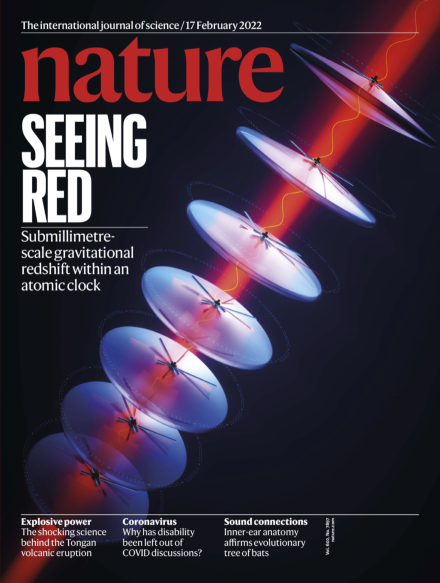
And the Ye group paper was even featured on the cover of this issue of Nature(!):

Volume 602 Issue 7897


Shimon Kolkowitz earns NSF CAREER award

Shimon Kolkowitz has already developed one of the most precise atomic clocks ever. Now, the UW­­–Madison physics professor has been awarded a Faculty Early Career Development (CAREER) award from the National Science Foundation (NSF) to use his atomic clocks to potentially answer some big questions about the physics of our universe. The five-year, $800,000 in …

Read the full article at: https://www.physics.wisc.edu/2021/12/15/shimon-kolkowitz-awarded-nsf-career-award/

Shimon Kolkowitz awarded two grants to push optical atomic clocks past the standard quantum limit

Optical atomic clocks are already the gold standard for precision timekeeping, keeping time so accurately that they would only lose one second every 14 billion years. Still, they could be made to be even more precise if they could be pushed past the current limits imposed on them by quantum mechanics. With two new grants …

Read the full article at: https://www.physics.wisc.edu/2020/12/22/shimon-kolkowitz-awarded-two-grants-to-push-optical-atomic-clocks-past-the-standard-quantum-limit/

Q-NEXT collaboration awarded National Quantum Initiative funding

The University of Wisconsin–Madison solidified its standing as a leader in the field of quantum information science when the U.S. Department of Energy (DOE) and the White House announced the Q-NEXT collaboration as a funded Quantum Information Science Research Center through the National Quantum Initiative Act. The five-year, $115 million collaboration was one of five …

Read the full article at: https://www.physics.wisc.edu/2020/08/26/q-next-collaboration-awarded-national-quantum-initiative-funding/